I hadn't read this play since my own high school days. I remembered it as being good but depressing, and my memory was accurate.
Why this play? I have launched this year into a literary exploration of the American Dream with my Year 13 class. We will be reading The Great Gatsby, and I have been toying with other texts which we might explore. As I googled my way around the theme, I kept coming up against Death of a Salesman on reading lists, time and time again. I was dubious, but we have a number of dog-eared copies in the resource room, so I decided to re-read it and see.
Miller's play is a good example of the adage that 'there is a reason why the Classics become Classic'. It won a Pulitzer Prize in 1949, and a Tony Award. It has been adapted into two feature films and a number of TV movies. It is old, but it is still very good.
In fact, like Orwell's Nineteen Eighty-Four---written around the same time---seventy years later, the underlying themes and questions of this drama are still as relevant as ever: the tension between the 'American Dream' and the reality; the societal pressure to live up to some norm or expectation, regardless of one's aptitude or personality; the realities of the way that families can replicate destructive patterns of thought and behaviour from one generation to another.
My question after re-reading it is no longer whether it is worthy of study, but around the sensitivities and appropriateness of teaching a text which deals with suicide. I will need to discuss this with the class and see what they think.
Saturday, 9 February 2019
Friday, 1 February 2019
'If I Die in a Combat Zone: Box Me Up and Ship Me Home' by Tim O'Brien
This is an autobiography, or memoir, of Tim O'Brien's tour of duty in the Vietnam War. If you want to understand what the Vietnam War was like for an American soldier then this is a great memoir to read. He is college educated, thoughtful and reflective, but tells it like it is.
I was re-reading this book to decide whether I want to teach it this year with my Year 12 class. I still haven't decided. One of the things I noticed particularly this time around was the way the author switches from first to second person narrative. He uses second person (you) when he is talking about the worst parts of the fighting. I came to the conclusion that it could be more a way of distancing himself from the memories than a way of involving the reader, but it is a bit disconcerting switching pronouns from chapter to chapter.
What I like about this memoir is that he is completely honest about his feelings. He is drafted and doesn't want to go. He believes that the war is not a just war; that the US involvement is wrong. But he also feels his duty as a citizen. He considers dodging the draft, and later considers deserting before he is sent to Vietnam, but he can't bring himself to do either. The memoir starts in Vietnam for the first few chapters and then flashes back to him getting drafted, and after that tells the story in chronological order. For this reason, I think it is a more useful book to teach than his Pulitzer-nominated collection of short stories (The Things They Carried). Students tend to find that collection disjointed and don't get an overall picture. But the short stories are better crafted writing than the autobiography. Meh. Can't decide!
Monday, 28 January 2019
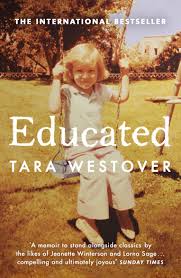
'Educated' by Tara Westover
This memoir was a challenging read on the emotional level, but I was completely riveted from the outset. Westover was brought up in rural Idaho by strongly religious survivalist parents who would not send her to school or use medical intervention of any kind, including antibiotics. The family was Mormon, but their views were more radical than the Mormon church, and Westover insists that her memoir is not a story about Mormonism or any organised religion.
Tara's birth was not registered and she essentially did not exist in the legal sense of paperwork, until her mother applied for a birth certificate for her when she was 9. She was taught at home to read and use basic number skills, but after that was put to work in her father's junkyard and assisting her mother, who was a herbalist and midwife.
At the age of 16, Tara decided she wanted an education. She bought an algebra textbook and began teaching herself the maths she needed to pass a college entry certificate. At 17, she left her family against her father's wishes to attend the Mormon college, Brigham Young University. She ultimately ended up studying at Harvard and at Cambridge University in the UK, graduating with a doctorate in History. In the process of gaining her education, the beliefs she had been taught by her family were challenged and eventually she ended up estranged from her parents and some other family members.
Her family was... dysfunctional, I think would be the best descriptor. Her father's belief that everything was God's will meant that he was negligent to the point of causing accidents to happen to the children. Later, one of her brothers subjected her to emotional abuse and physical violence. I found the story of Tara's quest to be educated a painful but inspiring one. I finished it some days ago now, but it has stayed in my mind and I keep thinking about it and about her experiences.
One of the messages that I have taken from the book is the benefit of self-education and of motivation to learn:
If you are trying to decide whether or not you want to read 'Educated', I suggest watching this video of an interview with Tara Westover:
Tara's birth was not registered and she essentially did not exist in the legal sense of paperwork, until her mother applied for a birth certificate for her when she was 9. She was taught at home to read and use basic number skills, but after that was put to work in her father's junkyard and assisting her mother, who was a herbalist and midwife.
At the age of 16, Tara decided she wanted an education. She bought an algebra textbook and began teaching herself the maths she needed to pass a college entry certificate. At 17, she left her family against her father's wishes to attend the Mormon college, Brigham Young University. She ultimately ended up studying at Harvard and at Cambridge University in the UK, graduating with a doctorate in History. In the process of gaining her education, the beliefs she had been taught by her family were challenged and eventually she ended up estranged from her parents and some other family members.
Her family was... dysfunctional, I think would be the best descriptor. Her father's belief that everything was God's will meant that he was negligent to the point of causing accidents to happen to the children. Later, one of her brothers subjected her to emotional abuse and physical violence. I found the story of Tara's quest to be educated a painful but inspiring one. I finished it some days ago now, but it has stayed in my mind and I keep thinking about it and about her experiences.
One of the messages that I have taken from the book is the benefit of self-education and of motivation to learn:
"My parents would say to me all the time: you can teach yourself anything better than someone else can teach it to you. Which I really think is true. I hate the word “disempower,” because it seems kind of cliché, but I do think that we take people’s ability to self-teach away by creating this idea that that someone else has to do this for you, that you have to take a course, you have to do it in some formal way. Any curriculum that you design for yourself is going to be better, even if it’s not the absolute perfect one. You will follow what you care about." (Tara Westover in an interview with Vanity Fair)
If you are trying to decide whether or not you want to read 'Educated', I suggest watching this video of an interview with Tara Westover:
Sunday, 27 January 2019
'The Adventures of Nanny Piggins' and 'Friday Barnes: Girl Detective' by R A Spratt
I finished reading this book on 16 January. It was recommended to me by a young cousin who was reading the third Nanny Piggins book at a recent family gathering. I don't tend to read a lot of junior fiction these days, more YA, so it was a nice change to discover this author.
Nanny Piggins is a pig who gets a job as a Nanny. In one sense she is the total opposite of the Mary Poppins syndrome - she is pretty much the world's worst Nanny (for example, she and the children hide and pretend there is no one home when the truancy officer knocks on the door...)
In another respect, Nanny Piggins does have parallels to Mary Poppins in that both of them have limited respect for the father of the household and generally subvert the paternal authority to side with the children.
I found the book funny and entertaining and would like to read the others in the series. You might enjoy the first paragraph:
After reading Nanny Piggins I read the first in another series by the same author: 'Friday Barnes: Girl Detective'. Friday is a kind of 'Matilda' character who has read a lot of books (including lots of detective stories) but has limited social skills. She applied to university to study medicine and was accepted until they found out she was only 11, so she has to go to high school. Friday is not super keen on the idea but with some reward money from solving a police case she pays for her tuition at a private school. Socialising is challenging for her, as is the fact that she has to solve some mysteries. I enjoyed this story also and will look out for others in the series. I finished this book on 18 January.
No Stone Unturned: A Lexi Carmichael Mystery by Julie Moffat
I finished reading this book on 15 January. I really enjoy this series though it is 'fun reading' rather than great literature. It is a kind of romance/spy story/hacker story mix. The main character, Lexi, attracts a lot of trouble and some of her predicaments are quite funny.
Lexi is a math nerd hacker genius who works in IT security in Washington DC. Her fiancé is a spy/hacker who used to work for the Vatican and now works for the NSA. Some of the books in the series involve travel in Italy, which I enjoy reading about. This latest book includes some fun Dan Brownish kind of Vatican mystique and goings-on.
I'm not giving detail about this particular book as it would create spoilers for someone starting at the beginning of the series. I will just say that the story is about Lexi and her fiancé and how a mystery from the past threatens them and their relationship.
If you enjoy spy/thriller/romance with a touch of humour then you might enjoy this series. The first book is 'No One Lives Twice'.
Lexi is a math nerd hacker genius who works in IT security in Washington DC. Her fiancé is a spy/hacker who used to work for the Vatican and now works for the NSA. Some of the books in the series involve travel in Italy, which I enjoy reading about. This latest book includes some fun Dan Brownish kind of Vatican mystique and goings-on.
I'm not giving detail about this particular book as it would create spoilers for someone starting at the beginning of the series. I will just say that the story is about Lexi and her fiancé and how a mystery from the past threatens them and their relationship.
If you enjoy spy/thriller/romance with a touch of humour then you might enjoy this series. The first book is 'No One Lives Twice'.
Wednesday, 9 January 2019
'Star of the North' by D. B. John
I decided to read this book after picking it up idly in a book store and seeing it was set in North Korea. It made me nostalgic for all those Cold War spy stories I used to read (my favorite was the Quiller series by Adam Hall aka Elleston Trevor).
I don't want to do any spoilers so it is hard to describe! The story follows various different characters including a CIA agent, a peasant woman, and a colonel in the North Korean army. It paints a very grim picture of life in North Korea, but it is also a story with hope in it and the idea of the value of humanity. It is very well written and I found it hard to put down.
I noted a number of nods to Orwell's Nineteen Eighty-Four, including use of some of his terms, such as 'thought police' and 'unperson'. One of the NK characters reminded me strongly of Winston's mentor and torturer, O'Brien. At one point there is a description of the mindset needed for survival in NK which is very reminiscent of Orwell's definition of 'double think'.
Just in case you think the plot is too far-fetched there is an author's note at the end explaining the reality behind a lot of the things described. I found this an engrossing story and it was entertaining while still leaving me plenty to think about.
I don't want to do any spoilers so it is hard to describe! The story follows various different characters including a CIA agent, a peasant woman, and a colonel in the North Korean army. It paints a very grim picture of life in North Korea, but it is also a story with hope in it and the idea of the value of humanity. It is very well written and I found it hard to put down.
I noted a number of nods to Orwell's Nineteen Eighty-Four, including use of some of his terms, such as 'thought police' and 'unperson'. One of the NK characters reminded me strongly of Winston's mentor and torturer, O'Brien. At one point there is a description of the mindset needed for survival in NK which is very reminiscent of Orwell's definition of 'double think'.
Just in case you think the plot is too far-fetched there is an author's note at the end explaining the reality behind a lot of the things described. I found this an engrossing story and it was entertaining while still leaving me plenty to think about.
Sunday, 6 January 2019
'Simon vs. The Homo Sapiens Agenda' by Becky Albertalli
This was a re-read of a title I discovered last year; after finishing 'Boy Erased' I desperately needed to read a happier coming out story.
Things start off badly when Simon is blackmailed by someone who accidentally gets access to his emails. The blackmailer eventually outs him online. That part is not so great, and Simon is understandably really angry about what the blackmailer has done by outing him:
“This was supposed to be—this is mine. I’m supposed to decide when and where and who knows and how I want to say it.” Suddenly, my throat gets thick. “So, yeah, you took that from me.”
However, there are a lot of positives in the story. Some of the good things are: the acceptance of Simon's sexuality by himself, his friends and family, and the relationship he is pursuing online with the mysterious Blue. He knows Blue is a boy at his school and he is desperate to meet him in person.
This is a great YA novel which explores the difficulties of coming out in a supportive and affirming way. It also takes a good look at the nature of friendship and at family relationships. The novel has also been made into a film called 'Love, Simon'.
Things start off badly when Simon is blackmailed by someone who accidentally gets access to his emails. The blackmailer eventually outs him online. That part is not so great, and Simon is understandably really angry about what the blackmailer has done by outing him:
“This was supposed to be—this is mine. I’m supposed to decide when and where and who knows and how I want to say it.” Suddenly, my throat gets thick. “So, yeah, you took that from me.”
However, there are a lot of positives in the story. Some of the good things are: the acceptance of Simon's sexuality by himself, his friends and family, and the relationship he is pursuing online with the mysterious Blue. He knows Blue is a boy at his school and he is desperate to meet him in person.
This is a great YA novel which explores the difficulties of coming out in a supportive and affirming way. It also takes a good look at the nature of friendship and at family relationships. The novel has also been made into a film called 'Love, Simon'.
Subscribe to:
Posts (Atom)